THE CARDBOARD HOUSE: THE STORY OF A PAPER BUILDING MATERIAL
Since 1978, our Archi4 office has been constantly looking for bio-ecological solutions for people and environmentally friendly construction.
This quest for the possibility of ecologically building cheaper, simpler and less dependent on the timber industry kept us busy. In 1993 our interest was aroused by the constructions of Shigeru Ban, the Japanese architect who realized the pavilion at the world exhibition in Hanover. He realized incredible half-timbered and dome constructions with varnished cardboard tubes. The high timber prices made it worthwhile to look further for solutions. The search for semi-industrializable elements could also reduce construction costs. The paper used is 100% recycled and the adhesives used are of mineral origin. So the ecological picture was correct.
Initially we found few direct options other than simply putting the tubes together – which Shigeru had already done.
The paper used is 100% recycled and the glues used are of mineral origin, so the ecological card was right
We realized several interior design projects with the single tube circuit, such as the reading corner commissioned by Stichting Lezen in the Royal Museum of Fine Arts in Antwerp (KMSKA). We developed the exhibition stand at the Antwerp Book Fair for blind and and in Brussels a showroom for audio applications for blind for the same Foundation.
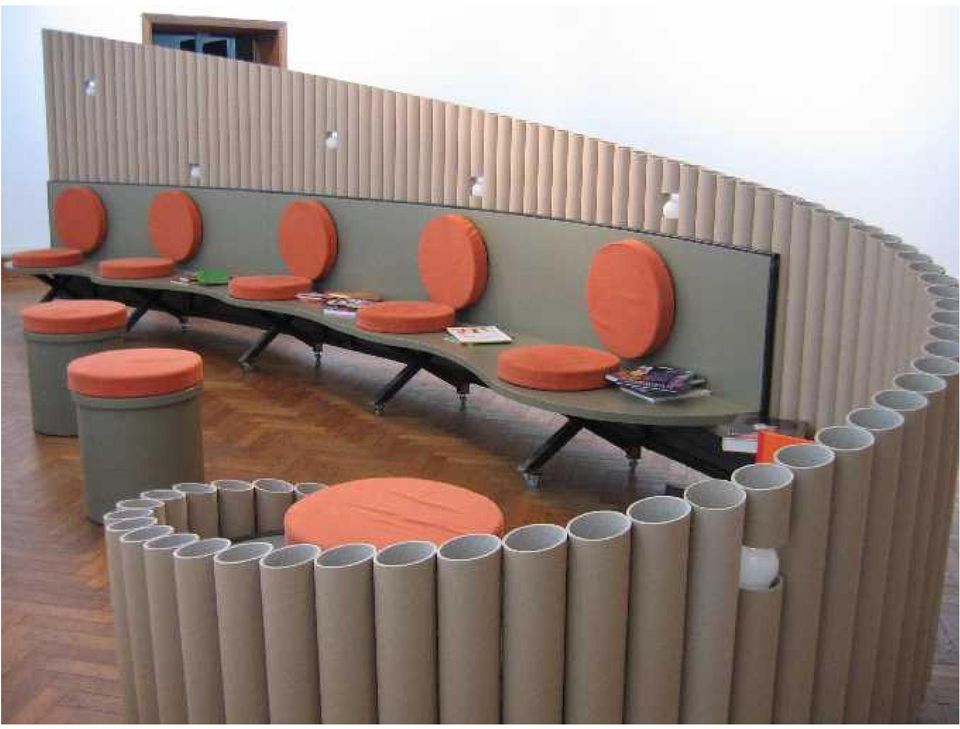
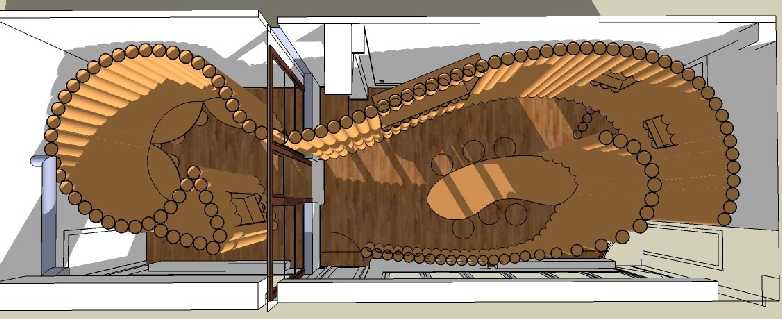
In the meantime, through a book by Shigeru Ban, I was made aware that he also makes houses with this method, simply placing the tubes against each other for emergency houses and churches. However, in our quest for a windproof and insulated construction, this was not a viable solution and so we searched another year for a solution.
The invention
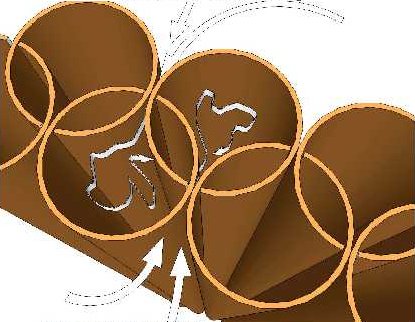
In an inspired moment, the idea was taken to fit the tubes together by just making one cut in it and slide them into each other. As can be seen in the drawings, this combination forms a saltire, or Saint Andrew’s Cross, which provides the transverse strength and with which a light and high structure can be realized.
Acoustic and thermal isolation properties 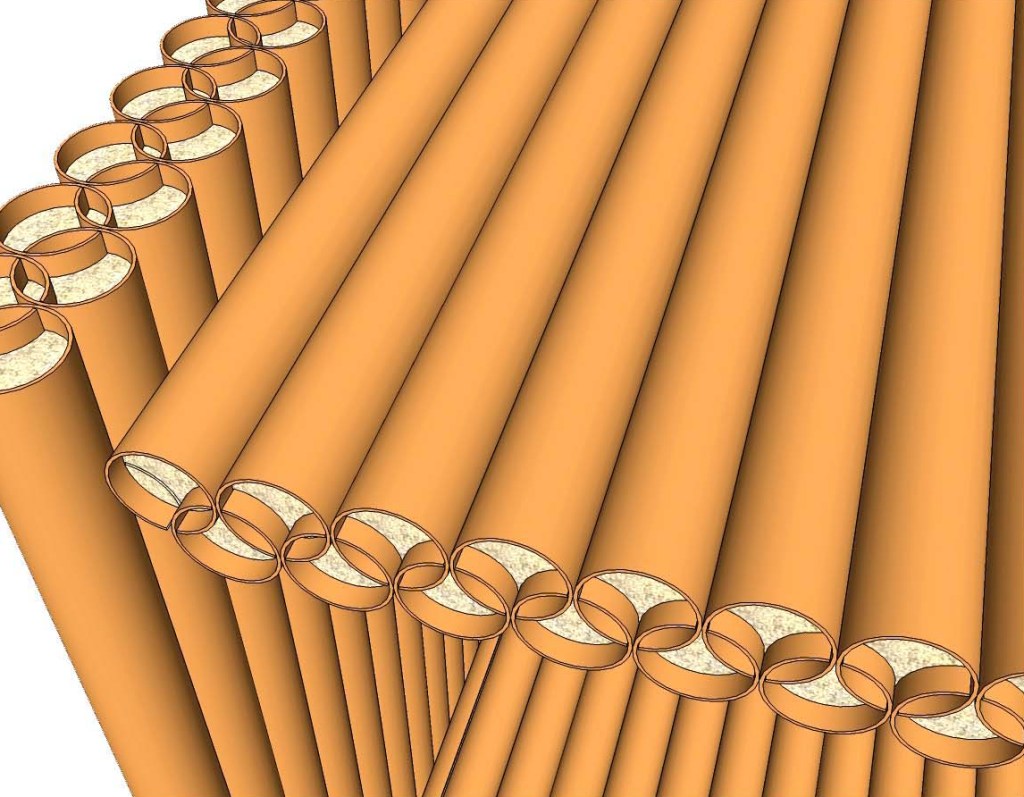
Olympas tubes filled with Isofloc isolation
In 2000, this led to the first test set-up with a friend carpenter Louis Baeten, who helped me with this prototype. One longcut in each tube gives the possibility to join them in an ‘olympic’ way – so the name was quickly found.
One longcut in each tube gives the possibility to join them in an ‘olympic’ way
A curious observation was made: the tubes when pushed together had a very good load-bearing capacity: they did not move a millimeter at my load of 90 kg. In 2008 the trial was repeated after the patent was secured (patent no. 1017679A4 July 6, 2007). With a millimeter correct laser measurement, only 5 mm deflection was determined after loading the tube group with a central load.
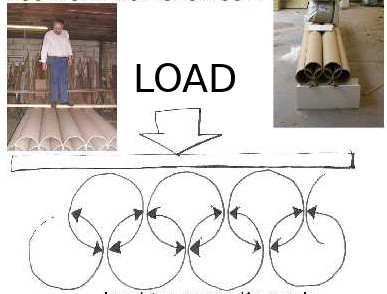
How does Olympas actually work?
By joining different round tubes together, a continuous structure can be formed without additional mechanical fastening techniques. By the action of forces that are transferred from one tube to the next, a neutralizing effect is created on the development of forces, which makes the combined whole very strong, like a truss beam that is built up with round shapes
The method can be used in all possible materials, from rigid to flexible tubes in cardboard, steel, polyethylene or acrylic glass. Applications are many:
- roofs and floors
- light and acoustic interior and exterior walls
- sheet piling to construction pits
- road or canal works with excavations (in steel or fiber cement)
- self-supporting bridge spans (see image)
- self-supporting and watertight roof covering for large spaces (where the bottom tube functions as a gutter), using a synthetic alternative in PE-tubes
- self-supporting sound-insulating vertical walls along motorways (tubes form hollow spaces that dampen sound)
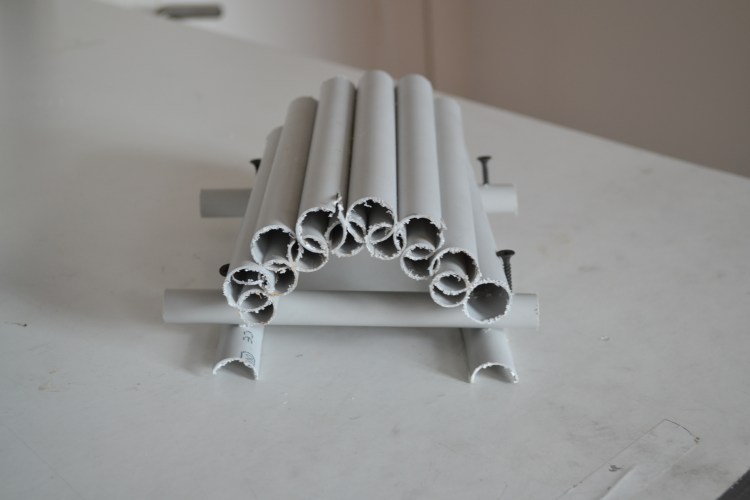
A first application of Olympas was made for the Hibernia school in Antwerp, where parents and teachers jointly built a sleeping room for the toddlers. This was a non insulation version, but proved its sound deadening properties.
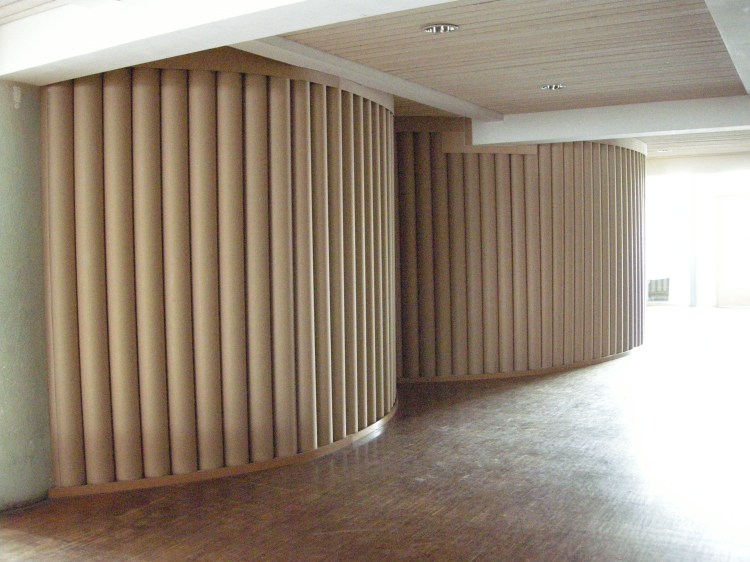
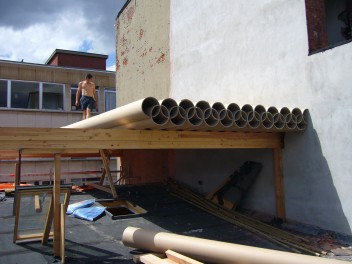
A second application was the family house in 2009 in Borgerhout (Antwerp) with a roof structure and a 5 meters high facade wall, carried out by the contracting company Ecoverbo. As can be seen in the photos, a blind facade was first built, from which the windows were cut out.
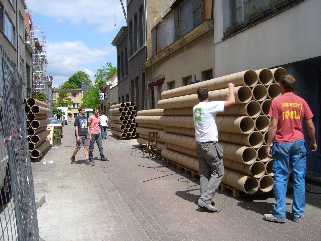

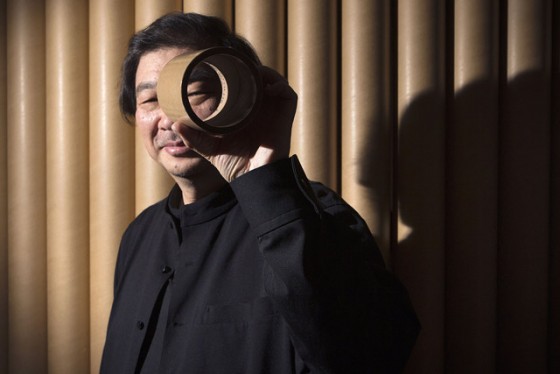
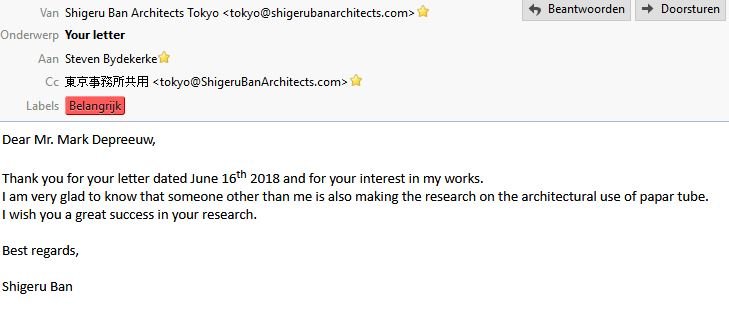
In 2018, we presented our innovation to Sigeru Ban, who was quite happy to see how the use of card board tubes as a construction element had inspired us.
 Olympas
You must be logged in to post a comment.